-01.avif)

THE GEOMETRIC TRUTH OF TEAM SHAPE
The Constellation™.

Shape Notes
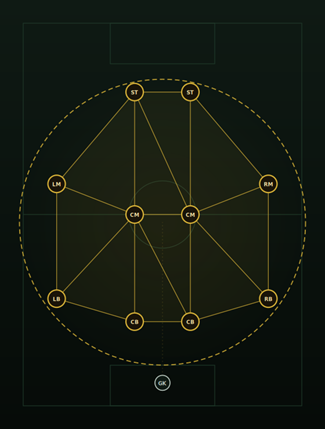
Two banks of four with a strike partnership. Connecting every player to their neighbors creates a web of triangles across the whole shape — interlocking triangles forming passing lanes from back to front.
Shape Notes
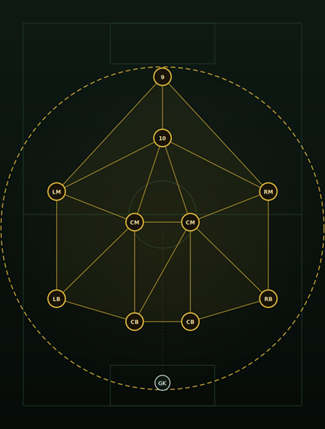
Back four, midfield four, a withdrawn #10 feeding a #9. The vertical stacking of the two strikers creates an extended diamond network through the spine.
Shape Notes
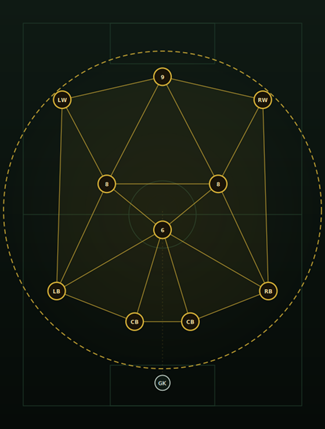
Back four, midfield triangle, front three. Produces the most classical triangle network in the game — every central player naturally triangulates with multiple neighbors, creating the rotational passing patterns associated with positional play.
Shape Notes
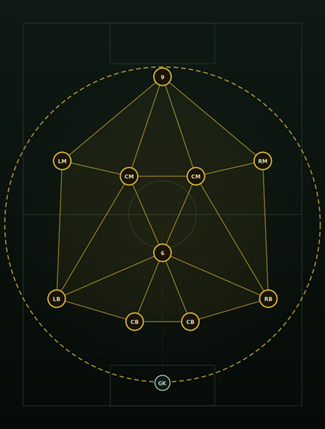
Back four, single pivot, midfield four, lone striker. The single #6 becomes the hub of a massive triangle network — connecting to every defender, every midfielder, and the #9.
Shape Notes
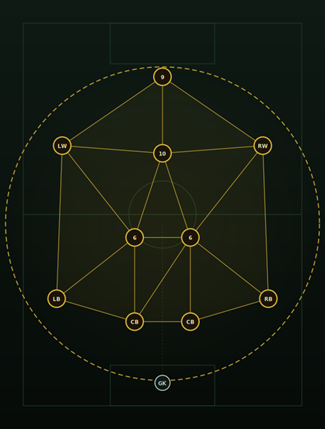
Back four, double pivot, attacking three, lone striker. The double-#6 creates parallel spines of triangles — two central conduits rather than one, giving structural redundancy in midfield.
Shape Notes
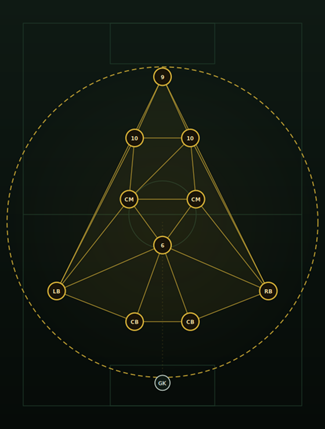
Back four, midfield three, two #10s, one striker. The narrow stacking produces a dense triangle network — nearly every pair of central players forms an edge.
Shape Notes
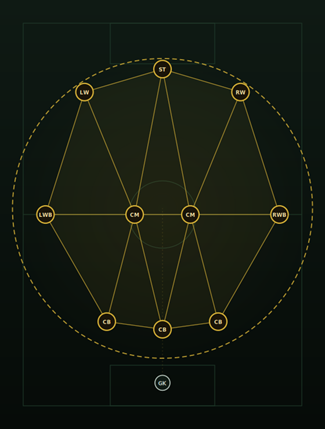
Back three, midfield four, front three. Wingbacks extend the circle dramatically wide, and the three-player defensive line creates a natural chain of defensive triangles across the back.
Shape Notes
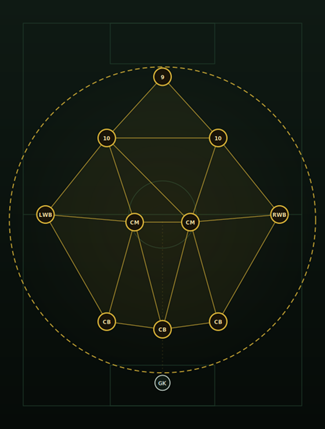
Back three, midfield four, two #10s, lone striker. The two #10s occupy the half-spaces, creating overlapping triangles with both wingbacks and the central midfielders.
Shape Notes
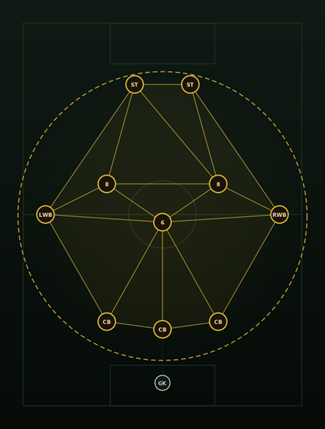
Back three, midfield five, strike pair. Wingbacks, #8s, and a holding #6 create a triangle-dense midfield — seven players across the middle third generate overlapping triangle clusters.
Shape Notes
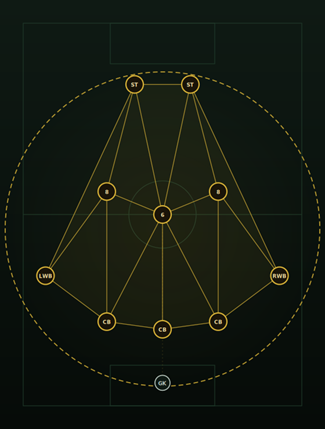
Back five, midfield three, strike pair. Mirrors 3-5-2 structurally but with the rim compressed vertically — same network of triangles, spun for defensive posture.
WHERE THE GEOMETRY BEGINS
Youth Constellations.
Shape Notes
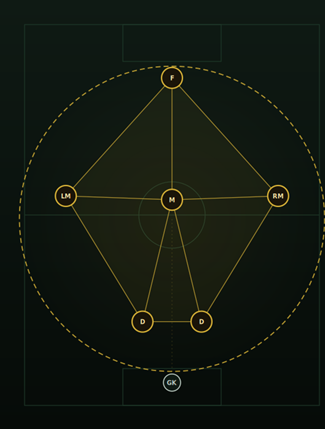
The simplest triangle constellation — 6 players form approximately 4 interlocking triangles. Perfect first shape for young players learning to see connections.
Shape Notes
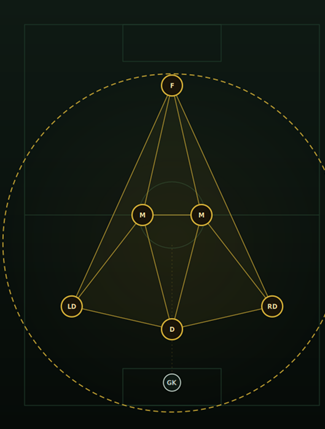
Back three creates a wide defensive triangle; two midfielders form the middle connection; striker sits at the tip. Teaches defensive cover through simple triangles.
Shape Notes
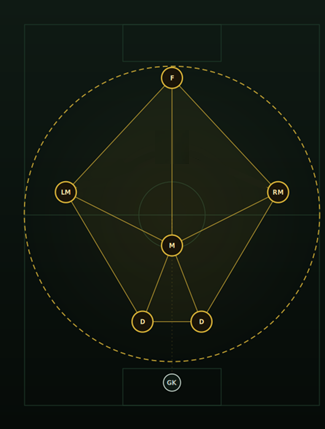
The diamond shape creates the richest triangle network possible in 7v7. Every player has 3-4 passing connections. One of the best youth shapes for teaching rotation.
Shape Notes
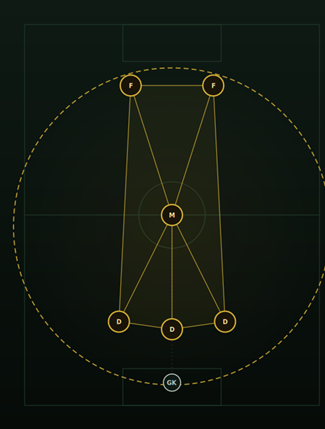
A back three creates a wide defensive triangle, with a single midfielder as the hub, and two strikers forming a front pair. Teaches partnerships both at the back and up top.
Shape Notes
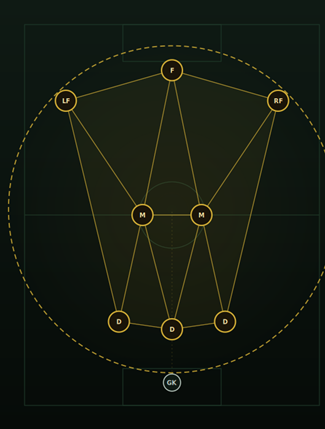
The canonical 9v9 shape generates a rich triangle network — a full web of passing lanes. Naturally teaches the rotational patterns that define 4-3-3 at 11v11.
Shape Notes
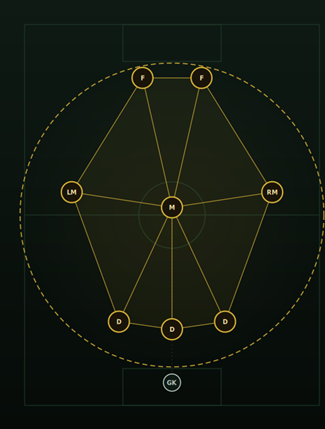
Three lines of three (back / midfield / front pair) creates a vertically-stacked triangle web. Great for teaching how to play through lines.
Shape Notes
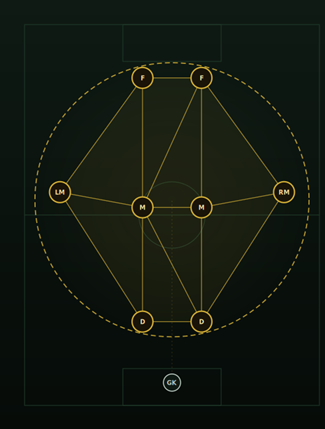
A back two with a midfield four and a strike pair. The wide midfielders create triangles that extend the circle dramatically, teaching full-width play.
Shape Notes
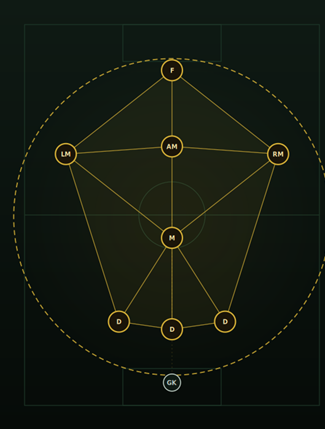
A taller, more staggered triangle network. The single #6 anchor becomes the hub of the shape, connecting to nearly every outfield player. Prepares young players for 4-2-3-1 at 11v11.
Shape Notes
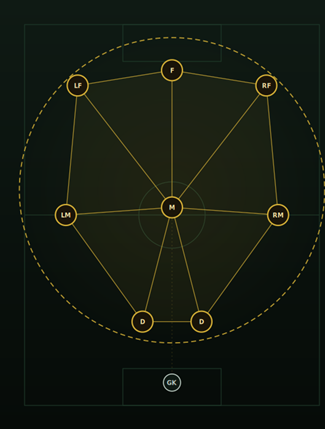
An attacking 9v9 shape. The front three extends the circle forward, creating a dense network of attacking triangles. Demands brave defending from the back two.